

Cooling down after aerial: a little recovery once you're home

If you're reading this, you've probably just gotten home from class. Your grip is spent, your core is still buzzing, and you feel that good kind of tired. Nice work today.
Before you collapse onto the sofa for the evening, give yourself a few minutes of gentle recovery. It's a small habit that makes a real difference — it's part of what turns a hard class into steady progress, and it's how you show up to your next session feeling ready rather than wrecked. You can do all of this at home, tonight, with no equipment.
What recovery actually does
Aerial work asks a lot of your body. It's serious physical training, and your nervous system knows it — during class you're running on adrenaline and effort, heart rate up, muscles firing hard. That's exactly where you want to be while you're training.
Winding down afterward helps your body shift back out of that revved-up state and into recovery mode, which is where the real adaptation happens. In plain terms: it settles the post-class buzz, brings your breathing back to normal, and tells your body the hard part is over.
It does a few practical things for the muscles you worked so hard, too. Gentle movement improves circulation to the areas under the most load, which helps clear out the fatigue. It reduces next-day soreness, so you're not wincing every time you reach for your coffee tomorrow morning. And over time, regular attention to these areas keeps you mobile and moving well.
Where aerialists hold the tension
Aerial is a full-body discipline, but a few areas take the brunt of it every class. These are the ones worth a little attention at home:
Forearms, wrists, and hands. Everything you did today ran through your grip. This is usually the first place you'll feel it in the morning.
Shoulders and lats. Your pulling muscles carried you up and held you there.
Neck. Often overlooked, and often tense — especially after inversions and anything that had you bracing or looking up.
Core and hip flexors. Working overtime on every invert, tuck, and hold.
A gentle routine to do at home
No equipment, no big production — five minutes of slow, intentional movement on your living room floor is plenty. Two rules: breathe deeply throughout, and never force anything. This is recovery, not a second workout, so keep everything soft and controlled.
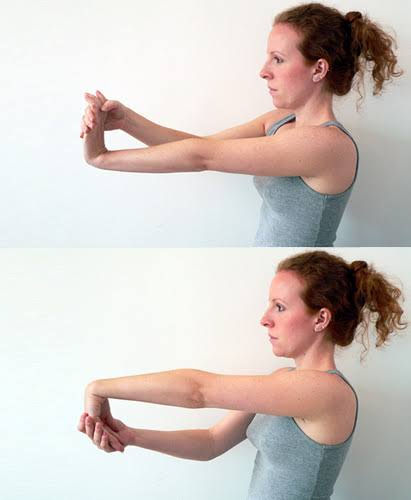
Wrist and forearm release. On hands and knees, turn your fingers to point back toward your knees and gently sit back until you feel a stretch through the forearms. Hold, breathe, and ease off if it's sharp. Then flip the hands and stretch the other side.
Neck stretch. Sitting tall, gently drop one ear toward the shoulder. Let the weight of your head do the work — no pulling. Hold for a few slow breaths, then switch. Bonus: while you hold, softly shift your gaze diagonally with your eyes only. It's a small trick that helps stimulate the vagus nerve and nudge your body further into that calm, recovery state.
Shoulder and lat opener. Reach one arm overhead and lean gently to the opposite side, feeling the stretch down your side body. Breathe into it, then swap.
Chest opener. Clasp your hands behind your back and lift slightly to counter all the pulling and reaching from class.
A few slow breaths to finish. Sit or lie down, close your eyes if you like, and take five long breaths. This is the part that tells your nervous system you're done for the day.
Add a glass of water while you're at it — hydration helps your muscles recover.
One tip for next time
If you're working toward your splits or a specific flexibility goal, keep this in mind for your next class: the best moment for deep, passive stretches like over-splits and middle splits is at the very end of class, when your body is fully warmed up. A cold body at home isn't the time to push into deep ranges. So save the intense flexibility work for the studio, and keep tonight's session gentle and restorative.
Make it a habit
The students who recover well are the ones who progress steadily and stay injury-free. It's not the flashiest part of training, but it's one of the most reliable. Give your body those few minutes tonight, and you'll feel the difference at your very next class.
See you in the air.
Not booked in yet, or curious about trying aerial for the first time? Have a look at our absolute beginners class and grab a spot on the schedule. All levels, all bodies — come as you are.
Comments