

Tired of the Gym? Why Aerial Arts Might Be the Workout You Stick With

Updated: May 29
Most people quit the gym within three months. Grinding away on machines in a mirrored room, not speaking to anyone, doing exactly the same thing every session... who wouldn't get bored?
Aerial arts is the opposite of that
At Aerials Amsterdam, people come in having never done anything remotely athletic and leave having climbed a piece of fabric hanging from a six-metre ceiling. They come back the following week because they want to know what comes next. That's the difference between fitness you force yourself to do and fitness that actually pulls you in.

What aerial arts actually is
Aerial arts covers any discipline performed on apparatus suspended from the ceiling. At Aerials Amsterdam, the two disciplines you'll train are:
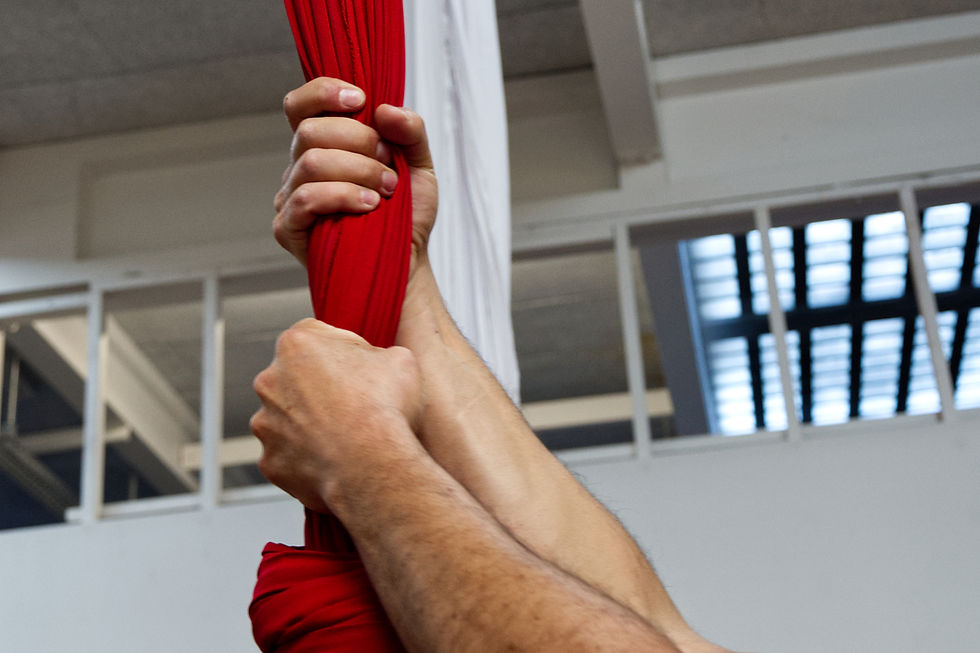
Aerial silks (sometimes called aerial tissue or fabric) — two long pieces of fabric that hang from the ceiling. You learn to climb, wrap yourself in the material, and hold positions in the air. It builds grip strength, arm and back strength, and body awareness in a way that no gym machine replicates.
Aerial hoop (also called lyra) — a metal ring suspended overhead. You work in and around it, learning to sit, spin, and move through poses. The rigid structure makes early moves feel more controlled, which a lot of beginners find reassuring.
Both start from zero. Both will work muscles you didn't know you had.
The honest bit: it's harder than it looks
Let's not pretend otherwise. If it wasn't hard it wouldn't be a workout.
"The next few days will definitely bring you sore muscles, especially in your arms and fingers if you are new to aerials. Actually, no matter how long you have been training, you will probably have some muscle strain after each and every training."
That's a real quote from one of our students. We're including it because it's true — and because the people who stick with aerial are the ones who found that soreness satisfying rather than discouraging. When your body is doing something genuinely new, it responds.
The other thing students say:
"It takes more strength than I thought it would, but the teachers explain everything very well and also offer individual counselling. I am very happy to have started."
Individual attention matters here. Classes at Aerials Amsterdam are capped at 14 people. Your instructor will spot what you're finding difficult and adjust — you're not just following along in a group of thirty.
"But am I strong enough?"
This is the question almost everyone asks before their first class. The answer is: you don't need to be.
Ilan, the founder of Aerials Amsterdam, has built the curriculum around this exact reality. Absolute beginners — people with no sports background — are the norm, not the exception. Most people who walk through the door for the first time have never trained anything aerial or acrobatic in their lives.
The way aerial works is that you build strength by doing it. The first obstacle is the climb — getting yourself up the fabric for the first time, which might take a couple of sessions. Once that clicks:
"A whole new world opens up with its countless ways of you wrapped up in the tissue — hip keys, inversions, crab locks, foot locks — things you have not heard about before."
You don't need to arrive with strength. You build it as the moves get more complex. The progression is built in.
Who trains here
Aerials Amsterdam runs classes for teens and adults, and the adult beginner classes regularly include people who have never done anything like this before — in their twenties, thirties, forties, and beyond.
Age is not a factor. Fitness history is not a factor.
If you've been thinking about trying something physical but the gym has never appealed to you, aerial is worth considering. The people who tend to love it are those who want to learn something — a skill, a movement, a new thing their body can do — rather than just clock time on equipment.
How the beginner experience works
Rather than a single drop-in, Aerials Amsterdam runs a 3-class trial for newcomers. One class tells you whether you like the idea. Three classes gives you enough time to start actually building something — and by the end, you'll have a clear sense of whether you want to continue.
The first session covers the basics: how to approach the apparatus safely, how to grip, how to manage your body weight. The "I can actually do this" moment usually comes here.
By the third session, you're doing things that would have looked impossible from the outside a week earlier.
No special kit required. No shoes — aerial is done barefoot. Just wear full-length leggings and a fitted top that covers your underarms (fabric against bare skin means friction — not pleasant). You can read our in-depth guide on what to wear to a class.

Why people stick with it
The gym works if you have a reason to be there. Aerial gives you one. Every session, there's something new to try, something you couldn't do last week, a move you're working towards. The learning curve is the motivation.
It's also, genuinely, a different kind of physical challenge. You're developing coordination, spatial awareness, grip strength, and core stability all at once — not by thinking about them, but by trying to get yourself into a position in the air.
If you've written off "exercise" because nothing has ever felt worth doing consistently, aerial might be the exception.


Thấy bạn bè nhắc nhiều jun88 nên mình vào lướt thử. Giao diện nhìn khá thoáng, chữ và từng phần nội dung được chia rõ nên xem nhanh không bị rối mắt. Mấy heading lớn cũng giúp nắm ý chính khá nhanh. Tổng thể bố cục gọn, các mục sắp xếp dễ theo dõi và click qua lại cũng khá mượt.
Vừa mở trang chủ mb66 lên là thấy giao diện kiểu đồng bộ thật, bấm qua lại không bị lệch nhịp hay phải đoán xem nút nằm đâu. Nội dung cũng chia thành từng khối rõ ràng nên lướt nhanh vẫn nắm được ý chính, không bị ngợp chữ. Mình thích cái cách họ viết kiểu “ăn khớp” ngay từ đầu, đọc vài dòng là hiểu họ muốn hướng tới trải nghiệm liền mạch chứ không màu mè. Kéo xuống thấy các tiêu đề và box tách bạch, nhìn phát là biết phần nào là nội dung chính, phần nào chỉ là thông tin kèm theo.
Dạo này mình thấy nhiều người bàn về mấy nền tảng giải trí trực tuyến nên cũng tò mò ghé xem thử họ trình bày trang ra sao. Mình không có ý đào sâu từng nội dung hay từng trò, chỉ muốn nhìn cách họ sắp xếp danh mục và đưa thông tin lên cho dễ theo dõi. Khi lướt qua, mình có vào trang chủ x88 để xem tổng thể, và cảm giác là các nhóm như thể thao, casino, game bài với slot được phân chia khá rành mạch, nhìn sơ là hiểu. Mình cũng để ý phần bảng dữ liệu được trình bày theo cột khá gọn, đỡ bị rối mắt. Menu thì đặt ở vị trí dễ…
Mình đánh giá cao cách https://loginhitclub.club/ tổ chức các danh mục. Những nội dung có liên quan được đặt gần nhau nên việc tìm kiếm khá thuận tiện, không phải mở nhiều trang mới rồi quay lại liên tục. Cách sắp xếp này đặc biệt hữu ích với người chưa quen website.
Có một lần mình đang đọc dở một bài tổng hợp trên mạng thì thấy h19 xuất hiện xen giữa phần nội dung. Lúc đó cũng không có ý định tìm hiểu gì sâu, chỉ tò mò bấm vào xem thử cho biết. Mình lướt nhanh vài mục để cảm nhận cách bố trí chung, và ấn tượng đầu tiên là mọi thứ được sắp xếp khá gọn gàng cùng các trò quen thuộc như slot, game bài, bắn cá nhìn vào không bị rối mắt. Xem xong mình quay lại bài đang đọc, nhưng trong đầu vẫn nhớ là giao diện khá dễ theo dõi.